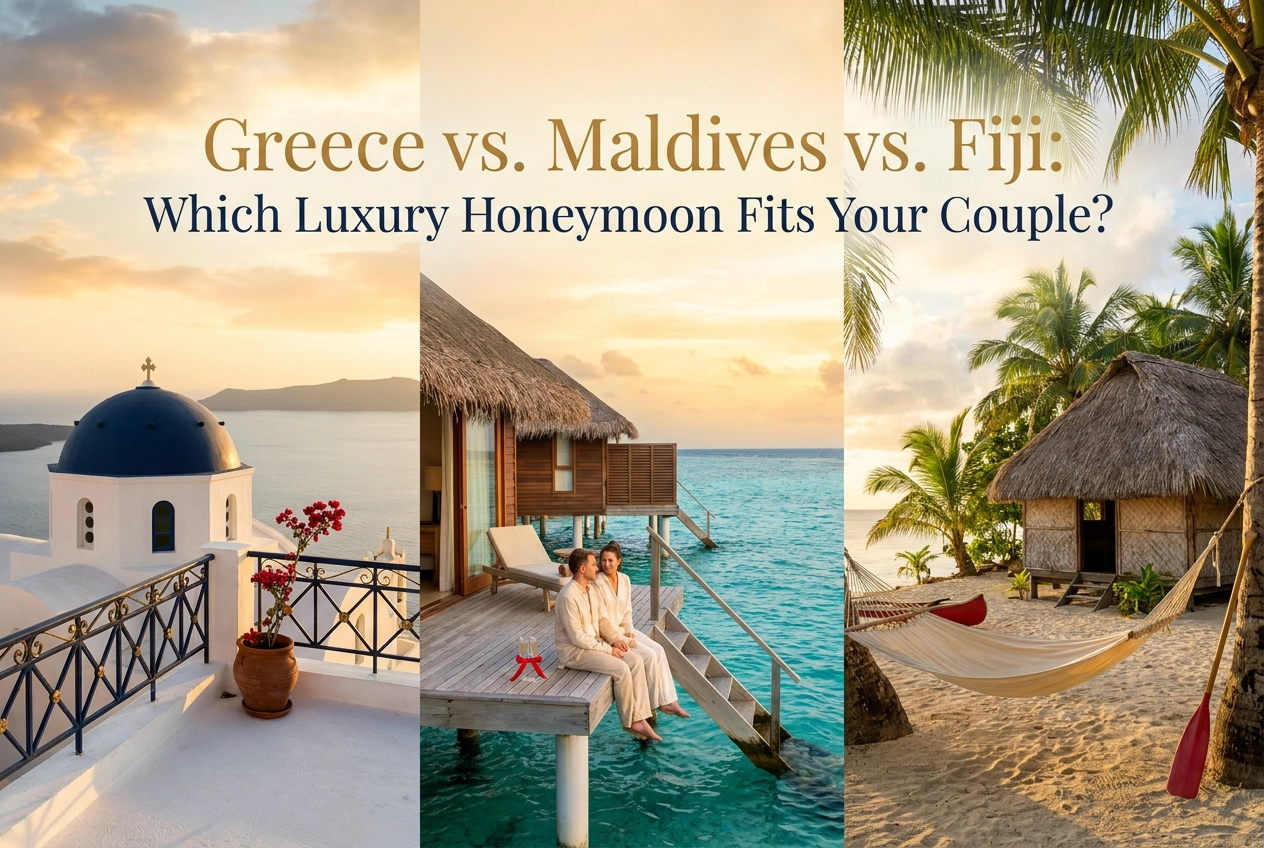
You have a shortlist. Greece, Maldives, Fiji. Maybe you built it from Instagram saves, a friend’s recommendation, or a late-night scroll through honeymoon forums. The problem is that all three destinations are genuinely exceptional, which makes the decision harder, not easier. Generic “top honeymoon destinations” lists will not help you choose, because they were never designed to.
The real question is not which destination is best. It is which destination is best for you, specifically. A couple drawn to ancient ruins, candlelit dinners overlooking the Aegean, and greece honeymoon packages built around cultural depth will have an entirely different experience than a couple who wants to disappear into an overwater villa and speak to no one for ten days. Fiji belongs to a different conversation altogether.
This guide cuts through the shortlist paralysis by matching each destination to a distinct couple archetype. You will learn how Greece, the Maldives, and Fiji differ across culture, seclusion, adventure, logistics, and cost. More importantly, you will learn how a luxury travel advisor turns those differences into a decision that reflects your actual priorities, not just an aesthetic.
Why All Three End Up on Every Shortlist (And Why That’s a Problem)

Greece is spectacular. So is the Maldives. So is Fiji. The problem isn’t the destinations; it’s that most couples arrive at all three simultaneously, treating them as interchangeable entries on a luxury honeymoon shortlist rather than fundamentally different experiences built for fundamentally different couples.
That convergence isn’t accidental. Travel magazine “best of” roundups, algorithm-surfaced Instagram reels, and content built to rank on popularity rather than relevance all funnel couples toward the same three names. The result is a shortlist that feels curated but isn’t. A couple who wants to wander ancient ruins and drink local wine in a hillside village is staring at the same list as a couple whose ideal honeymoon involves leaving the villa exactly once, to snorkel off the deck.
The real gap in most honeymoon planning content is compatibility, not quality. Every major ranking system measures a destination against other destinations. None of them measure a destination against you. That leaves couples in the awkward position of comparing a cliff-top cave hotel in Santorini against an overwater bungalow in Bora Bora against a private island in Fiji, with no framework for asking which one actually fits who they are as a couple.
Social-media-driven selection makes this worse in a specific way: it optimizes for the shot, not the experience. Seclusion-seekers book peak-season Santorini because the photos are undeniable, and arrive to find 10,000 other people had the same idea. Cultural explorers book a remote Maldives atoll because it looks romantic, and discover there is genuinely nowhere to go and nothing to learn beyond the resort’s curated programming.
The fix isn’t a better ranking. It’s a different framework entirely, one that starts with the couple rather than the destination. For anyone still building out their broader travel vision, these summer vacation ideas for every type of traveler illustrate how dramatically the right destination shifts when personal travel style drives the decision.
The sections that follow map each destination to a specific couple archetype, because that’s the only comparison that actually resolves the deliberation.
The Three Couple Archetypes That Drive This Decision
So what actually separates couples who thrive in each of these destinations from those who leave quietly disappointed? It comes down to three recognizable profiles.
Cultural Explorers want the destination to be a character in the trip, not a backdrop. They book a honeymoon the way they’d plan any meaningful travel: restaurants worth researching in advance, ruins worth waking up early for, a local market that isn’t on the hotel’s excursion list. The resort is home base, not the point.
Seclusion Seekers want the world to get very small, very fast. No itinerary, no agenda, no pressure to optimize the day. Privacy isn’t just preferred; it’s the entire value proposition. If the best afternoon involves doing nothing more than floating in warm water with their partner, that’s a perfect afternoon.
Adventure Divers and Active Couples measure a trip by what they did together. Shared firsts matter: a first dive, a surf lesson, a hike to a waterfall. These couples return from a honeymoon with stories about experiences, not descriptions of a view from a villa. For couples who fall into this category, romantic adventure getaways that combine luxury with genuine outdoor exploration are often a better fit than resort-centric packages.
Most couples are a blend. The practical question isn’t which archetype fits perfectly; it’s which one is dominant when they’re honest about trade-offs. A good luxury travel advisor surfaces that dominant priority by asking direct questions: What does the best day of this honeymoon look like? How many days before you’d want to leave the resort? Would you rather remember a sunset or a dive?
The trickier challenge is what might be called the Instagram override. A couple self-identifies as Seclusion Seekers, but both of their mood boards are filled with Santorini caldera views and blue-domed churches. Those images map to Greece, not seclusion. Booking the wrong destination for the right reason is a common and entirely preventable mistake. Catching it early, before a deposit is placed, is where the qualification process earns its value.
Greece: Built for Cultural Explorers Who Want Luxury on Their Terms
If you’ve already identified yourselves as Cultural Explorers, Greece is the destination that was built for you.
Greece works because the destination itself is the experience. Ancient ruins, whitewashed Cycladic villages, wood-fired tavernas, volcanic wine regions in Santorini, and the sheer variety of island personalities across a single itinerary, none of this is resort programming. It exists independently, and luxury accommodations simply give you the best possible base from which to engage with it. For couples who would feel quietly restless spending seven nights inside a single resort footprint, that distinction matters enormously.
How Luxury Shows Up in Greece
The luxury expression here is deliberately varied. Boutique cave hotels carved into the cliffs of Oia deliver the iconic Santorini aesthetic with genuine privacy. Private villa rentals in Crete put couples in working olive groves with personal pool access and no neighbors in sight. Forbes-rated properties on Mykonos offer polished, design-forward experiences for couples who want world-class service alongside the island’s energy. Small-ship Cyclades cruises thread the needle between comfort and discovery, anchoring in bays that larger vessels can’t reach.
Experiences That Justify the Trip
A private yacht day trip between islands remains one of the genuinely bucket list travel experiences worth every penny, unhurried, flexible, and impossible to replicate on a group tour. Sunset dinners in Imerovigli, positioned above Oia’s famous viewpoints, offer the same view with a fraction of the foot traffic. Athens cooking classes ground the honeymoon in something tactile and shared. And the archaeological sites, particularly Delos and Akrotiri, reward couples who time visits to early morning arrivals before tour groups arrive.
The Honest Trade-Offs
Peak season from June through August brings significant heat and crowds that actively undercut the romantic atmosphere Greece promises on Instagram. Shoulder season, specifically May and September, is the consistent advisor recommendation for luxury couples: warm enough for swimming, uncrowded enough for the slower pace that honeymoons actually need.
Logistics at a Glance
Greece is reachable from US East Coast cities with a nonstop or one-stop flight. US passport holders currently enter Greece without a visa, though ETIAS (launching late 2026) will require advance online authorization. Pricing is euro-denominated, with Mykonos and Santorini commanding a meaningful premium over other islands. Most advisors recommend at least 10 days for a multi-island itinerary to feel unhurried.
Couples who should look elsewhere: those prioritizing true seclusion, year-round warm swimming water, or a tight travel window that won’t support island-hopping.
Maldives: The Benchmark for Couples Who Want to Disappear Together
Where Greece rewards couples who want to explore, the Maldives rewards couples who want to stop. Entirely. The destination’s design logic is unlike any other on this shortlist: every element, from the resort layout to the activity menu, is engineered to make leaving feel unnecessary.
That’s not hyperbole. Resort accommodation accounts for 69% of all Maldives arrivals, which reflects a tourism model built almost entirely around private-island stays. You don’t share your island with a town, a highway, or another resort. You share it with your partner and a staff ratio that, at the top properties, approaches one-to-one.
The luxury expression here is specific. Overwater villas with glass floor panels let you watch reef fish without leaving bed. Private plunge pools sit directly over the lagoon. In-villa spa treatments mean a couples’ massage requires no reservation desk and no walk across a property. Sunset dolphin cruises and private sandbank dinners are standard inclusions at most five-star Maldives honeymoon packages, not upgrades.
The experiences that only exist here include seaplane arrivals, which recalibrate your sense of scale the moment you lift off Malé and see the atolls spread below you. Bioluminescent beach nights, where the tide glows electric blue with plankton, require no tour booking, just a walk to the waterline after dark. House reef snorkeling is steps from your villa at the better-positioned properties, and underwater restaurant dining remains a genuinely singular experience. For couples seeking luxury all-inclusive resort experiences where every detail is contained and curated, the Maldives sets the benchmark.
The honest trade-offs deserve equal weight. Per-night costs are the highest of the three destinations, compounded by the isolation logistics that make everything more expensive to import and operate. Cultural and culinary variety is minimal; you’re eating within resort programming for your entire stay. Couples who thrive on itineraries often hit a wall by day four, a phenomenon advisors call paradise fatigue, and it’s more common than honeymoon marketing acknowledges.
Logistics snapshot: Plan for a long-haul journey of roughly a day of total travel, typically requiring a connection through a Middle Eastern or Asian hub. US citizens should confirm current entry requirements with the Maldives embassy before booking, as policies can change. USD acceptance at resorts is common; confirm with your property before arrival. Most advisors recommend at least 7 to 10 nights to justify the journey. The Maldives is generally considered to have a favourable dry season; confirm the optimal window with your advisor.
Reconsider the Maldives if you naturally fill vacations with plans, crave cultural immersion, or are working within a budget where the geographic isolation premium would create financial stress throughout the trip.
Fiji: Where Active Couples and Adventure Divers Find Their Honeymoon
Where the Maldives engineers stillness, Fiji rewards motion. For couples who measure a great honeymoon by what they did together rather than where they sat, no destination in the luxury tier competes.
The Adventure Case for Fiji
Fiji’s waters are celebrated for extraordinary marine biodiversity. The Somosomo Strait on Taveuni Island is renowned for soft-coral diving. Cloudbreak, off the Mamanuca Islands, is widely regarded among surfers as a world-class reef break. Between those poles, couples can kayak through mangrove channels, hike to remote waterfalls, and explore volcanic interior landscapes, all without leaving a single luxury property’s orbit.
How Luxury Shows Up in Fiji
Fiji honeymoon packages are built on two island chains: the Mamanucas (closer to Nadi, good for first-time visitors) and the more remote Yasawas. Private-island resorts on both chains offer overwater bures that carry something the Maldives equivalents often lack: genuine cultural warmth, thatched architecture rooted in tradition, and staff who treat hospitality as a cultural value rather than a service standard. For serious divers, high-end liveaboard vessels provide multi-day itineraries through sites shore-based resorts cannot reach. If you’re weighing whether a bundled all-inclusive resort structure works for your Fiji trip, the answer depends heavily on how much island-hopping your itinerary requires.
Defining Experiences
Learning to dive together as a first certification is one of the most commonly cited Fiji honeymoon highlights, and beginner dive infrastructure is well-established here. Village visits with sevusevu, the formal kava ceremony that precedes any respectful entry, offer cultural grounding that feels nothing like a curated resort excursion. Helicopter transfers between islands turn logistics into a moment. Taveuni’s waterfall hikes round out an itinerary that gives couples genuine shared stories.
Trade-offs and Logistics
Fiji is a long-haul destination, closer to a direct flight from the US West Coast but significantly longer from East Coast cities, so factor total travel time when setting your minimum trip length. Advisors recommend a substantial stay that combines a resort base with island-hopping or a liveaboard segment to justify the journey. US tourists enter visa-free (confirm current duration limits before booking). Luxury resorts bill in USD alongside the Fijian dollar.
Fiji has a wet season that overlaps with Northern Hemisphere winter months and can disrupt outdoor-heavy itineraries. Resort quality also varies more widely across Fiji than across the Maldives, making professional curation more consequential here, not less.
Reconsider Fiji if: your honeymoon priority is rest rather than exploration, water-based activities don’t appeal to either of you, or you’re flying from the East Coast and travel time is a hard constraint.
Destination vs. Destination: The Practical Comparison Luxury Couples Actually Need
Each destination’s archetype fit is only half the decision. The logistics layer is where couples either confirm the right choice or quietly talk themselves into the wrong one.
Flight time sets your minimum trip length. Greece is reachable from the East Coast with a nonstop or one-stop flight, making a 10-day trip genuinely viable without burning the first two days in transit recovery. The Maldives requires a long-haul journey of roughly a day, typically via a Middle Eastern or Asian hub; anything under 8 nights struggles to justify that investment. Fiji is closer from the US West Coast but significantly longer from the East Coast. Where you live shapes which destinations are even realistic given your time off.
Cost floors differ more than marketing copy suggests. The Maldives carries the highest nightly rate floor of the three, driven by the logistical reality of private-island isolation. Supplies, staff, and infrastructure all cost more when everything arrives by boat or seaplane. Greece offers the widest price range, from boutique Cycladic hotels under $500 per night to ultra-luxury cave suites well above $2,000. Fiji’s private-island resorts match Maldives pricing at the top end, but mid-range options exist for couples who want to extend their stay with an inter-island segment.
Peak seasons don’t overlap, which matters if your wedding date is fixed. Greece peaks June through August; book top Santorini and Mykonos properties well in advance for those windows. The Maldives is generally considered to have a favourable dry season; confirm the optimal window with your advisor. Fiji’s best conditions tend to fall outside the wet season months that overlap with Northern Hemisphere winter. No two destinations share the same sweet spot, so couples with set dates may find one destination far easier to book than another at their tier.
Visa requirements are stable but not static. All three are currently visa-free or visa-on-arrival for US passport holders. Greece is introducing ETIAS, an electronic travel authorization, in late 2026; it is not a visa, costs EUR 20, and processes quickly, but couples planning late-2026 honeymoons need to apply in advance. Entry requirements across all three can shift; an advisor monitors these so nothing surfaces at check-in.
Accommodation type and package structure complete the picture. Greece leads in villas and boutique hotels, with packages built around island-hopping logistics and guided cultural experiences. Maldives packages are largely resort-contained; the destination is the itinerary. Fiji packages increasingly bundle seaplane or helicopter inter-island transfers with dive certifications, reflecting the destination’s active-couple orientation. If you want a deeper walkthrough of how these logistics fit into a full planning timeline, this complete travel planning guide covers every stage from initial decision to arrival.
Red Flags: When a Destination Looks Right but Isn’t
The logistics comparison above tells you what each destination costs and when to go. What it can’t show is the gap between what couples imagine and what they actually experience when the destination is mismatched to their personality.
The Santorini in August trap is the most common. Couples picturing intimate candlelit evenings and quiet cliffside sunsets book peak-season Santorini, then discover that Oia’s sunset viewpoint draws hundreds of visitors at once, restaurant waits stretch past an hour, and the overall atmosphere skews closer to a party destination than a slow romantic retreat. Summer volume makes that reality visible at every turn.
Paradise fatigue is the Maldives’ quiet problem. Active couples who book an overwater villa can find that by day three, with no town to explore and no activity requiring them to leave the lagoon, restlessness sets in. The experience is genuinely extraordinary for the right couple; for an active couple, it becomes expensive inertia.
Fiji’s weather gamble catches couples who assume “tropical” means “sunny.” Fiji’s wet season overlaps with Northern Hemisphere winter months, which coincide with many winter wedding dates. Heavy rain during that window isn’t just inconvenient; it can ground helicopter transfers, shut down dive sites, and confine couples to their bures for days at a stretch.
The seclusion miscalculation in Greece works the other way. Couples who specifically want isolation sometimes book a Greek island thinking the quieter reputation will hold. Even the islands marketed as alternatives to Santorini draw significant summer crowds; the social and tourism density of the Aegean in July and August surprises couples who expected privacy.
A qualified luxury travel advisor surfaces all four of these mismatches during the planning conversation, before a deposit is placed, by asking what a good day on the honeymoon actually looks like rather than which destination photographs best.
What a Luxury Travel Advisor Actually Does That a Search Engine Can’t
Catching mismatches before booking is one part of the advisor’s job. Executing the trip flawlessly once the destination is chosen is the other.
A search engine returns results. An advisor asks questions. Before a destination is ever discussed, a good advisor qualifies a couple on factors that never appear in search queries: how much daily activity they actually want, how they respond to social environments, how curious they are about local food and culture, how sensitive they are to long-haul travel, and whether they have more flexibility on dates or on destination. Those answers determine which of the three destinations is a genuine fit and which ones would look beautiful in photos and feel wrong in person.
Property-level knowledge is where the advisor advantage becomes concrete. Star ratings don’t tell you which Maldives resort sits directly above its own pristine house reef, ideal for beginner snorkelers who aren’t ready for a boat excursion. They don’t distinguish which Santorini villa property sits far enough from Oia’s main strip to feel genuinely private, versus which one markets “seclusion” while sitting a three-minute walk from bar crowds. They don’t identify which Fiji lodge employs a resident dive master whose instruction quality is worth organizing an entire itinerary around.
Timing is equally non-negotiable. A booking platform can show availability; it cannot cross-reference your wedding date, your available leave, and the correct seasonal window for the destination you’ve chosen. Fiji’s dry season, Greece’s shoulder season, and the Maldives’ peak window don’t overlap. Getting this wrong costs more than comfort.
Smart Alec Travel’s approach to luxury honeymoon packages combines Forbes-rated hotel access with direct relationships at private-island resorts and boutique properties across all three destinations. That access produces pre-trip briefings detailed enough that couples arrive knowing exactly what to expect, with no logistical friction waiting for them at check-in.
The full-service scope covers inter-island transfers, private excursion bookings, dietary and accommodation preferences communicated to properties before arrival, and contingency planning for weather disruptions or itinerary changes. That same standard of detail applies whether Smart Alec is coordinating corporate travel logistics in Nashville or managing a two-island honeymoon across the South Pacific.
The One-Minute Match Guide: Which Destination Is Yours?
All the advisor expertise covered above narrows to a single practical question. Here is the shortest path to your answer.
Choose Greece if your ideal honeymoon day starts by walking out the resort gates. You want ancient ruins, local tavernas, regional wine, and the texture of a living culture around you. Luxury is the baseline, not the destination. Greece honeymoon packages are built for couples who want to discover something, not just arrive somewhere.
Choose the Maldives if privacy is your non-negotiable. You want zero itinerary pressure, a week that moves from snorkeling to spa treatments to sunset without a single decision that matters. Budget is not the binding constraint. Maldives honeymoon packages deliver an engineered intimacy that no other destination matches at scale.
Choose Fiji if your best honeymoon day is defined by what you did together. Diving the Somosomo Strait, surfing Cloudbreak, trekking to a waterfall, experiencing a village ceremony. Fiji honeymoon packages offer adventure-active couples luxury that feels warm and human rather than curated for a brochure. The longer flight from most US cities is genuinely worth it for the right couple.
Consider combining two destinations if you and your partner match different archetypes. A 14 to 18 day itinerary can pair Greece with a Maldives stay, or add a Fiji extension to a broader Pacific routing. An advisor structures these combinations so both profiles are served, not compromised.
The one question that resolves all three options: What does the best day of this honeymoon actually look like?
If your answer involves leaving the resort, Greece or Fiji wins. If it involves never wanting to leave, the Maldives wins.
Answer that honestly, and the destination selects itself.
The Right Luxury Honeymoon Starts With the Right Questions
If the one-minute guide helped you identify your archetype, you already have what most couples skip entirely: a starting point that isn’t an Instagram feed.
The honest conclusion of this comparison is that Greece, the Maldives, and Fiji are not ranked options. Each is the right answer for a specific couple, and the wrong answer for a different one. The goal was never to crown a winner; it was to help you recognize which destination was built for you.
At Smart Alec Travel, the conversation about luxury honeymoon packages starts with the couple, not the destination shortlist. Founder Alec Gutierrez applies the same archetype-first approach across every market his team works in, whether that’s Greece, the Maldives, Fiji, or closer to home, as couples planning New York travel packages for a city-based celebration will recognize.
The actionable step is simple: before you compare overwater bungalow layouts or Santorini villa views, define your archetype. Name the best day of the trip before you book it. Then let the destination follow. Reach out to Smart Alec Travel to start that conversation.
Conclusion
Greece, the Maldives, and Fiji are all exceptional. That’s exactly what makes choosing between them so difficult without the right framework. The destination that fits your honeymoon is the one matched to your archetype as a couple, not the one dominating your social feed this season.
Three takeaways to carry forward: first, couple identity drives destination fit, not the other way around. Second, a wrong destination cannot be rescued by a flawless property. Third, the questions asked before booking matter more than the options compared during it.
The best luxury honeymoons are designed before they are booked. That design starts with honest conversation about who you are together and what you actually want from the most significant trip of your life.
Smart Alec Travel is ready to have that conversation. Reach out today and let your archetype lead the way.