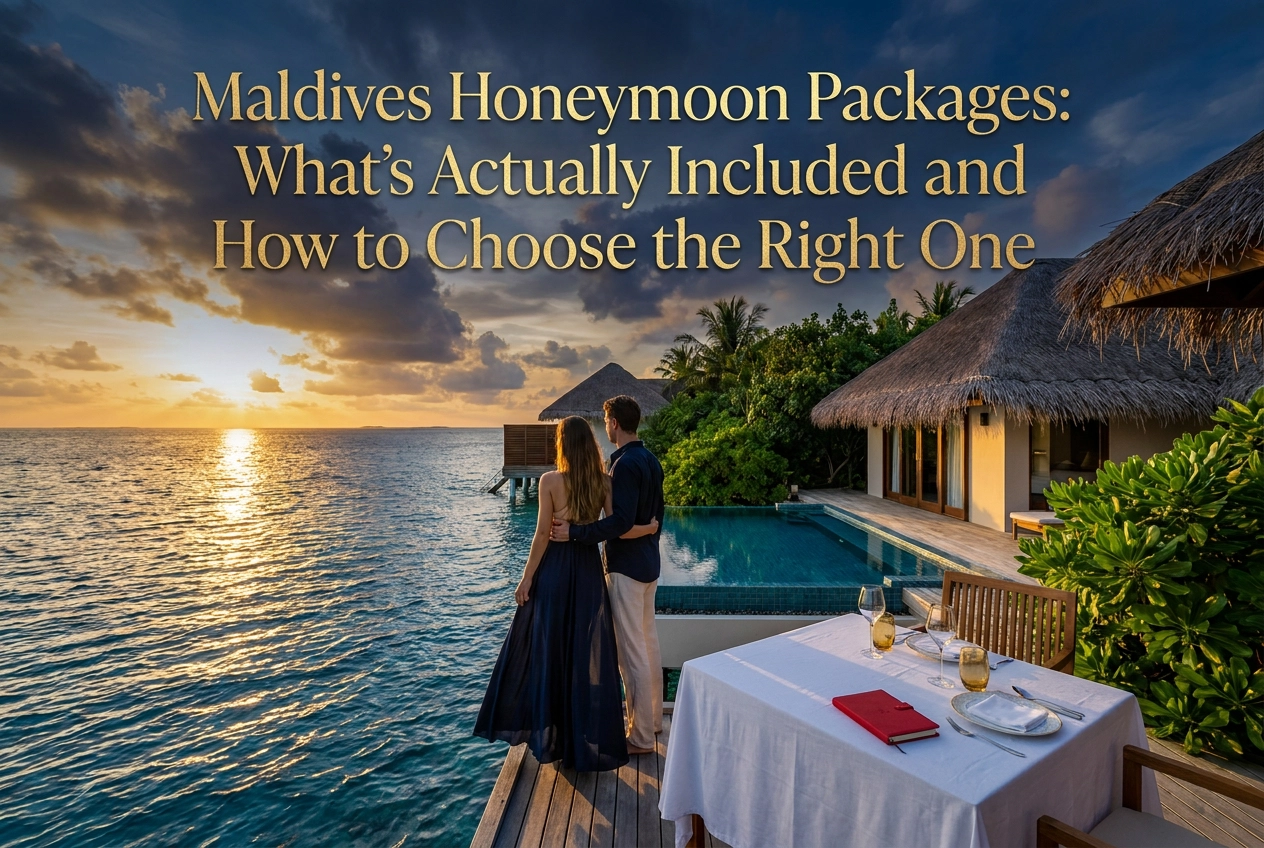
Every Maldives honeymoon package looks extraordinary on paper. Overwater villas, turquoise lagoons, private beaches, and sunset dinners all appear in the brochure. But here is the uncomfortable truth: two packages priced within a few hundred dollars of each other can deliver experiences that are worlds apart, and most couples only discover the difference after they have already paid.
The problem is not dishonesty. It is a lack of the right framework for comparison. When you do not know what variables actually matter, price becomes the default metric, and price alone will consistently mislead you.
This guide cuts through the noise. Using Maldives honeymoon packages as the focus, you will learn the five variables that separate a forgettable trip from an exceptional one: villa type, transfer method, meal inclusions, resort environment, and advisor access. You will also get a concrete evaluation checklist, a breakdown of what packages genuinely cost by tier, and guidance on when to book for the best value. By the end, you will know exactly how to read a package description, ask the right questions, and make a decision you will not regret.
Why Maldives Honeymoon Packages All Look the Same (And Why That’s a Problem)
Open nearly any Maldives honeymoon package and you will find the same structure: 7 nights, full-board, flights excluded, priced per couple. That standardized format creates the illusion of a level playing field. It is not one.
Resort websites compound the problem. Turquoise water photography, overwater villa hero shots, and phrases like “romantic escape” or “honeymoon inclusions” appear across properties at every price point. The terminology is interchangeable by design. When the language and imagery look identical, price becomes the default comparison metric, and that is exactly where buyers get misled.
The same price bracket can contain wildly different products. Two packages listed at similar prices might include entirely different villa categories, opposite transfer types, and meal plans with hundreds of dollars per day in actual value difference. Price signals budget, not experience quality. Treating it as a quality proxy is one of the most common and costly mistakes honeymooners make.
The opacity is not accidental. Resorts advertise a low base rate, then recover margin through ancillary fees, à la carte surcharges, premium beverage charges, and specialty dining that carries no affordable on-island alternative. A package that looks complete on the booking page can accumulate significant unbudgeted daily spend once you are actually there, a gap that only becomes visible when you read the full inclusion list.
What you are actually comparing when packages look the same is marketing copy, not product. Understanding that is the prerequisite to evaluating them correctly.
If you are also considering other destinations or trip styles, these summer vacation ideas covering every type of traveler offer useful context for how the Maldives compares to other premium getaway formats. For now, start with the geography.
Before You Compare Packages, Understand Atoll Geography
Before you evaluate a single resort name or package price, you need to understand what you’re actually choosing between geographically.
The Maldives spans 26 atolls across roughly 870 km of ocean, with over 1,192 coral islands scattered across that distance. Picking a resort without knowing which atoll it sits in is like booking a hotel without first deciding which city you’re visiting. The location determines almost everything that follows.
Atoll location controls your transfer. Resorts in North Malé Atoll are typically reached by speedboat in 20 to 45 minutes from the main airport. Resorts in more remote atolls require a domestic flight or seaplane, often adding several hours and significant additional cost per couple to your arrival, costs that are frequently excluded from base package pricing. That gap matters when you’re comparing two packages at the same headline price.
Atoll location also shapes what’s underwater. Reef structures, coral density, and marine species distribution vary significantly across the archipelago. Some atolls feature open lagoon systems with abundant coral formations; others are more enclosed with less marine diversity. If snorkeling or diving is part of why you’re going, the atoll is the relevant variable, not the resort’s overwater villa photography.
Development density is uneven. North Malé Atoll is the most resort-heavy area in the Maldives. If exclusivity and isolation matter to you, and for most honeymooners considering luxury all-inclusive resorts they do, a more remote atoll may be worth the additional transfer complexity.
Any Maldives honeymoon tour package that leads with resort names or price tiers before establishing atoll context is asking you to skip the most important variable. Always resolve geography first.
Variable 1: Overwater vs. Beach Villa (This Is Not a Cosmetic Choice)
Once your atoll is locked in, the next decision carries just as much weight: overwater villa or beach villa. These are frequently listed side-by-side in package descriptions as though the choice is simply a matter of budget. It is not.
Overwater and beach villas deliver structurally different experiences. An overwater villa places you directly above the lagoon, with step-down access to the water from your private deck, unobstructed horizon views, and a degree of seclusion that no beach villa can replicate. A beach villa gives you more outdoor living space, direct sand access, and a quieter, more grounded atmosphere. Neither is inferior; they attract different travelers.
Not All Overwater Villas Are Equal
The category name tells you almost nothing about what you’re actually getting. Key variables that package descriptions rarely surface:
- Construction age and renovation history. A villa built in 2008 and never updated will feel dated regardless of its position or price.
- Lagoon depth beneath the villa. A deck cantilevered over deep, clear water looks dramatically different from one sitting above a shallow reef flat that turns murky at low tide.
- Deck size and usability. Some overwater decks comfortably hold sun loungers, an outdoor shower, and a plunge pool. Others are narrow platforms with barely enough space to stand.
- Visual separation from neighboring villas. Mid-row overwater villas often face directly onto another villa’s deck, eliminating any sense of seclusion.
- Indoor-outdoor flow. The best villas dissolve the boundary between interior and exterior; lesser ones have sliding doors that open onto a cramped balcony.
What to Ask Before You Book
Do not book a villa category. Book a position. Ask your advisor for specific villa numbers or building locations, confirm when the structure was last renovated, and verify whether overwater villas sit above deep lagoon water. A corner overwater villa with unobstructed views is a materially different product than a mid-row villa facing another villa’s deck, even when both appear identically priced in the package listing.
Variable 2: How You Get There Changes Everything About the Experience
Your villa choice determines what you wake up to. Your transfer choice determines how you arrive, and that first impression carries more emotional weight than most Maldives honeymoon packages ever acknowledge.
The four transfer types, and what each actually means:
Speedboat (20 to 45 minutes) serves resorts in North and South Male Atoll and is the most common, most affordable option. It is entirely adequate, but it is a boat ride, not an experience.
Domestic flight plus speedboat is required for resorts in more remote atolls. This combination adds several hours of travel time and typically $450–$1,000 per person to your total cost. That surcharge is frequently absent from base package pricing, which means two packages listed at the same price can represent very different actual expenditures once transfers are factored in.
Seaplane is what most people picture when they imagine arriving in the Maldives. The aerial view of the atolls from low altitude is widely considered the most memorable part of the arrival experience. The tradeoff is real: seaplane transfers typically run $500–$1,500 per person round trip, operate only during daylight hours, and are weather-dependent. If your flight from Male lands at night or runs late, you will not be taking a seaplane that day.
Helicopter transfers exist at a small number of ultra-luxury resorts. They are the fastest and most private option, but carry a significant cost premium above even seaplane pricing.
The practical rule that applies to every category of Maldives honeymoon tour packages: any package that lists “airport transfers included” without naming the transfer type has left a major cost variable undefined. Confirm the exact method, the duration, and whether it is bundled or billed separately before you compare any two packages on price.
Transfer logic applies to other destinations as well. If you appreciate this kind of structural planning approach, our curated guide to the best Alaska vacation packages applies the same framework to a very different kind of bucket-list trip.
Variable 3: What ‘All-Inclusive’ Actually Means in the Maldives
The same scrutiny you just applied to your transfer type deserves to be applied to your meal plan, because “all-inclusive” in the Maldives means something different at almost every resort.
There is no universal industry standard governing what the label covers. Two packages at identical price points can include radically different things, and the gap often translates to hundreds of dollars per day in unbudgeted spending.
Understanding the Meal Plan Tiers
Half-board (HB) covers breakfast and dinner at the main restaurant. That sounds workable until you factor in lunch. On a private island resort, a midday meal carries full resort pricing with no off-property alternative, no quick café, and no leaving the island. The cumulative lunch cost across a seven-night stay can be substantial and is rarely foregrounded in package comparisons.
Full-board (FB) adds lunch, but the coverage stops there. Alcohol, specialty restaurants, in-villa dining, and most beverages beyond water are excluded. Dinner at the overwater fine-dining venue, a bottle of wine with your meal, a nightcap at the bar, all of it goes on your room tab.
All-inclusive packages close more of those gaps, but not all of them. Premium spirits, imported wines, and minibar restocking charges are routinely excluded even from AI-labeled packages. Do not read the headline label. Read the full inclusion list, line by line, before comparing any two packages.
The Honeymoon Inclusion Trap
Honeymoon packages frequently feature a complimentary private dinner or sunset cruise. That inclusion is almost always one-time. A second private dining experience, or any special-occasion meal you want to recreate, is billed at full resort pricing. Before booking, confirm explicitly which inclusions are one-time gestures and which are unlimited.
For deeper context on how these tiers compare across resort types, the guide to all-inclusive resorts: types, what’s included, and how to choose is worth reviewing before you finalize any package.
When you model total food and beverage spend honestly, a higher-priced all-inclusive honeymoon package frequently costs less than a lower-priced half-board option. Package price is not the comparison metric. Total spend is.
Variable 4: Adults-Only vs. Couples-Friendly Mixed Resorts
Meal inclusions clarified, the next variable is one most packages never mention at all: whether your resort accepts children.
Adults-only resorts are engineered from the ground up for couples. Pool configurations, dining atmospheres, activity programming, and staff-to-guest ratios are all calibrated for quiet and intimacy. The environment feels deliberately unhurried because it is.
Couples-friendly mixed resorts are not a lesser product, but they serve a different experience. Villa quality and service standards can be identical to adults-only properties, yet pool decks, beach stretches, and restaurant dining rooms will include families and larger groups. Whether that matters depends entirely on what you’re optimizing for.
The problem is that package marketing rarely surfaces this distinction. Many luxury honeymoon packages present resorts from both categories side by side, using the same romantic language and similar photography, without flagging which properties accept children. You can do significant research and still not know.
If atmosphere and seclusion rank above every other priority for you, treat adults-only status as a hard filter. Apply it before you evaluate villa type, transfer options, or meal inclusions. No amount of overwater villa quality compensates for a honeymoon morning disrupted by an environment that wasn’t built for couples.
A useful proxy when adults-only status is unclear: villa count. Resorts with fewer than 50 villas, particularly private-island properties positioned at higher price points, tend to attract an overwhelmingly adult clientele even without a formal policy. The combination of price and positioning does the filtering naturally. When you can’t confirm adults-only status directly, check the villa count and ask your advisor about the typical guest profile.
For a broader framework on applying these filters in sequence, our complete travel planning guide walks through the full decision process from first priorities to final booking.
Variable 5: Why Advisor Access Is a Package Feature, Not a Nicety
Once you’ve filtered for resort type, you’ve addressed four of the five variables that actually determine whether a Maldives honeymoon package delivers what it promises. The fifth is different in kind, not just degree.
Maldives resorts operate through tiered distribution channels. Agent-only rates, preferential villa allocations, and honeymoon amenity packages exist on booking portals that are structurally inaccessible to the public. Booking direct or through a general online travel agency doesn’t mean you’re bypassing the middleman and saving money; it means you’re accessing a narrower inventory at a less favorable rate structure.
A specialist advisor with contracted resort relationships can reach room categories, upgrade pathways, and bundled inclusions that simply don’t appear on any public-facing booking platform. That gap is real and it compounds across a multi-night stay.
The more important value, though, is informational. An advisor who has physically inspected a property can tell you which villa positions to request by number, which specialty restaurants justify the surcharge, and which transfer combinations to avoid given your arrival time. That kind of guidance cannot be reverse-engineered from a resort website.
Resort websites produce curated marketing narratives. Every image is optimized, every description is framed for conversion. An advisor’s job is to hold that narrative against your actual priorities and tell you where they diverge. That is a fundamentally different function than what any public research process can replicate.
When you’re evaluating Maldives honeymoon packages, “does this include access to a specialist advisor who knows this resort firsthand?” is a legitimate screening question. If the answer is no, that should weigh on your decision.
Smart Alec Travel, founded by Alec Gutierrez, maintains direct relationships with Maldives properties across resort categories. That means honeymooners gain access to negotiated inclusions and insider property knowledge that no public package listing can replicate. When the experience you’re planning is once-in-a-lifetime, the booking channel is not a minor detail.
The Evaluation Checklist: How to Compare Packages Without Getting Misled
Now that you understand each variable, put them to work before you compare a single price. Run every package through this sequence in order.
Step 1: Atoll and transfer first. Identify which atoll the resort sits in and what transfer type connects it to Malé Airport (MLE). As covered above, transfer type, duration, and cost vary significantly by atoll, seaplanes typically run $500–$1,500 per person round trip and operate in daylight only. Confirm whether any of this is included in the package price before moving forward.
Step 2: Get specific on the villa. Ask for the exact villa category, its position within the resort, and the year of its last renovation. For overwater villas, confirm whether the deck sits above a deep lagoon or shallow reef. A mid-row overwater villa facing a neighboring deck is a fundamentally different product from a corner villa with open-water exposure. Request specifics in writing, not a category label.
Step 3: Request the full meal inclusion list. As detailed in Variable 3, “full-board” and “all-inclusive” mean different things at different resorts, premium spirits, specialty restaurants, in-villa dining, and minibar charges are commonly excluded even from packages marketed as all-inclusive. Read the full list, not the headline label.
Step 4: Apply the resort type filter. Confirm adults-only or mixed before evaluating anything else about ambiance. As noted in Variable 4, resorts with fewer than 50 villas typically offer greater seclusion regardless of formal adults-only status, so scale matters alongside classification.
Step 5: Define the honeymoon inclusions precisely. Identify each honeymoon-specific benefit: private dinners, spa credits, room décor, excursions. Then confirm whether each is a one-time inclusion or available throughout the stay. A single complimentary sunset dinner is not the same as recurring dining credits.
Step 6: Verify your advisor’s relationship with the resort. As outlined in Variable 5, whether your booking channel holds a contracted relationship with the property and whether the advisor has personally inspected it determines whether the information you’re receiving is firsthand or repackaged marketing copy.
Price comparison only becomes meaningful after all six filters are applied. Two packages at identical headline prices can represent entirely different total costs and experiences. If you are also planning future family vacation packages or group travel, the same filtering logic applies: inclusions and advisor access matter far more than the number at the top of the quote.
When to Book and When to Go: Seasonality Affects More Than Price
Once your checklist is built, timing determines whether you can actually book what you’ve identified.
The Maldives operates on two seasons. The dry northeast monsoon (November through April) delivers calmer seas and the clearest water visibility of the year, making it the preferred window for snorkeling and diving. The wet southwest monsoon (mid-May through November) brings heavier rainfall, reduced underwater visibility, and meaningfully lower package pricing.
That pricing gap is significant. Peak season rates command a significant premium over shoulder-season equivalents, a differential worth exploring with your advisor when finalising travel dates.
The booking window is equally important. The most desirable overwater villa categories at top resorts fill well in advance during peak season, particularly around Christmas and New Year. If your ideal villa category is specific, waiting until four months out is not a strategy; it is a concession.
Weather also affects how you arrive. Seaplane transfers operate only in daylight and are subject to delay or substitution during the wet season when storms and reduced visibility interrupt flight windows. Couples with tight international connections or fixed arrival schedules should weigh this carefully when selecting their atoll and transfer type.
Late April through early May is the practical sweet spot for couples who want peak-season conditions without peak-season pricing. It is the window that rewards couples who plan ahead but stay flexible.
What Do Maldives Honeymoon Packages Actually Cost by Tier?
Once you’ve locked in your travel window, the next question is straightforward: what should you actually budget?
The following ranges are illustrative benchmarks based on industry experience; actual package costs vary by resort, season, and inclusion structure, always confirm current pricing with your advisor.
All prices below are per couple, for 7 nights, excluding international flights.
Entry-level ($3,000–$5,000): Guesthouse islands, non-overwater villas, speedboat transfers, and half-board meal plans. You get the Maldives location and turquoise water. You do not get a private island, and your dining options off-resort are limited to none.
Mid-range ($6,000–$12,000): Overwater villas at 4-star resorts, full-board dining, and speedboat or domestic flight transfers. This tier delivers the core Maldives honeymoon experience without the premium resort positioning or seaplane arrival.
Luxury ($12,000–$20,000): Private-island resorts with overwater pool villas, seaplane transfers, and all-inclusive dining. At this tier, the physical product changes materially: fewer guests, higher villa quality, and the seaplane arrival that most couples picture when they imagine the Maldives.
Ultra-luxury ($20,000–$40,000+): Fewer than 30 villas per resort, butlered service, helicopter transfers, and fully personalized itineraries. The distinction here is not just amenity level; it is scale, exclusivity, and the degree to which the resort operates around you rather than alongside you.
These ranges move based on three factors: travel season, villa category within a resort, and whether transfers and honeymoon inclusions are bundled into the package price or charged separately. A mid-range package that adds seaplane transfers and all-inclusive dining can close most of the gap to luxury-tier total spend before you notice it on the invoice.
As established earlier, total cost modeling, not the package rate, is the only reliable comparison metric. Two packages at identical headline prices can represent dramatically different total costs once meals, transfers, and ancillary resort charges are fully accounted for.
Choosing a Maldives Honeymoon Package the Right Way
You now have the five variables and the checklist. Here is how to sequence them in practice.
Get everything in writing before you compare. Request the full inclusion list, not just the meal-plan label. Ask for the specific villa position and its last renovation date. Confirm whether the resort is adults-only. These three steps, applied before any price comparison, eliminate the packages that look equivalent but are not.
Start with geography. Before you look at a single resort name, identify which atoll it sits in and what the transfer from Malé Airport looks like in terms of type, duration, and cost. A seaplane transfer to a remote atoll can add $1,000 or more per couple and is weather-dependent. That single variable reshapes the budget and the arrival experience before you have reviewed any other detail.
Work with a specialist, not a search engine. An advisor with direct resort relationships and firsthand property knowledge can access villa allocations, honeymoon amenities, and rates that no public platform surfaces. That is a structural advantage, not a marketing claim. If a Maldives honeymoon ranks among the bucket list travel experiences worth every penny, it deserves more than a generic online booking process.
Smart Alec Travel’s honeymoon planning service is built on exactly this methodology. Reach out to discuss your priorities and let us handle the comparison work with access to information that isn’t available anywhere public.
Conclusion
The Maldives is a remarkable place to begin a marriage. Getting there on the wrong package, in the wrong villa, on the wrong atoll, is a genuinely costly mistake. Getting there the right way creates a memory that stays with you for the rest of your life.
The checklist and variables in this guide give you the framework. Now let someone with real access do the comparison work for you. Reach out to Smart Alec Travel and tell us what matters most. We will handle everything else.